Every month, CyberClaims reviews dozens of cases involving fraudulent crypto websites. By the time most victims reach out, the damage has already been done. Funds have been sent, platforms have stopped responding, and the website involved has often already disappeared.
As we move into 2026, scam URLs are becoming more convincing, more short-lived, and harder to identify at a glance. Many are designed to look like legitimate trading platforms, wallet services, or recovery companies. Others impersonate well-known crypto brands or lure users through fake airdrops and promotions.
This article outlines the types of scam URLs CyberClaims is seeing most frequently, along with real examples reported by victims, and explains how to spot dangerous domains before interacting with them.
⚠️ The URLs shown below are shared for awareness only. Do not visit or interact with them.
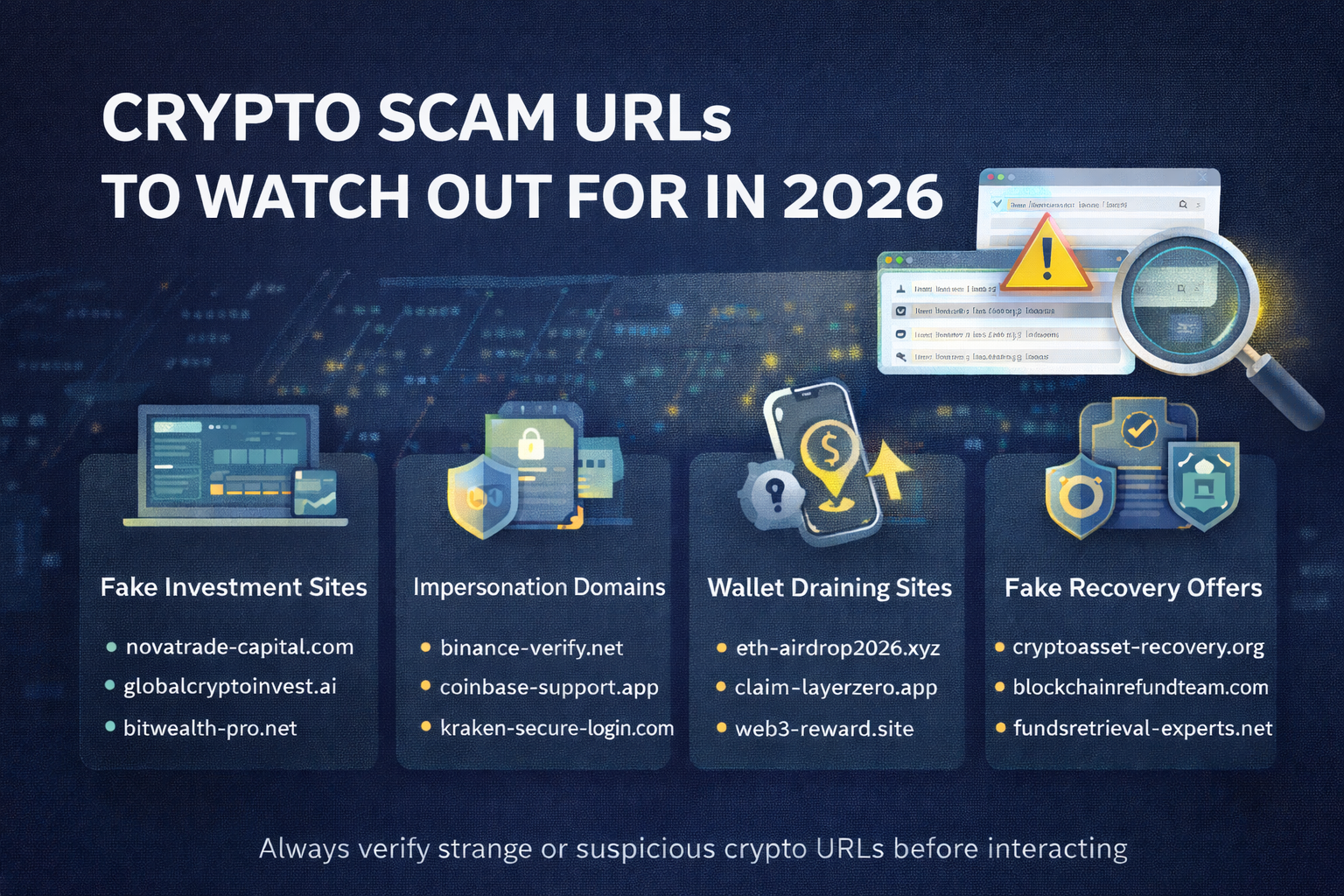
Fake Crypto Trading and Investment Platforms
The most common cases CyberClaims handles still involve fake investment platforms. These websites are often professionally designed, feature live price charts, and display fabricated account balances to make the platform appear legitimate.
Victims are encouraged to deposit crypto, see “profits,” and are then blocked from withdrawing unless they pay additional fees such as taxes, liquidity charges, or verification costs.
Common characteristics CyberClaims sees
- Recently registered domains
- Generic platform names with financial terms
- No verifiable company registration
- Withdrawals permanently “under review”
Example scam-style URLs reported in cases
novatrade-capital.comglobalcryptoinvest.aibitwealth-pro.net
In most cases, these sites are taken offline once enough funds are collected, only to reappear under a new domain with the same structure.
Impersonation of Legitimate Crypto Brands
Another growing category involves websites impersonating well-known crypto exchanges and wallet providers. These URLs are often shared through phishing emails, SMS messages, or social media ads claiming there is an issue with your account.
The sites closely copy official branding and are designed to steal login credentials or prompt wallet connections.
Typical impersonation patterns
- Added words like verify, secure, support, or login
- Slight misspellings of real brand names
- Unfamiliar domain extensions
Examples seen in reported scams
binance-verify.netcoinbase-support.appkraken-secure-login.com
Once credentials are entered, accounts are often drained within minutes.
Wallet Drainers and Fake Airdrop Pages
Wallet-draining scams have increased significantly going into 2026. These sites promote free token claims, NFT mints, or exclusive rewards and require users to connect their wallet.
Approving a transaction on these sites often grants permission for a malicious smart contract to transfer funds out automatically.
Red flags CyberClaims frequently sees
- Countdown timers and urgency
- “Claim now” messaging
- No transparent project details
Example scam-style domains
eth-airdrop2026.xyzclaim-layerzero.appweb3-reward.site
Legitimate projects do not pressure users to approve transactions without full transparency.
Fake Recovery and Refund Websites
A particularly harmful trend CyberClaims continues to encounter is secondary recovery scams. These target people who have already lost money and are actively searching for help.
These websites claim to recover funds using “blockchain investigators,” “legal teams,” or “government partnerships.” In reality, they exist only to extract additional fees.
Common warning signs
- Guaranteed recovery promises
- Requests for upfront payments
- Use of fake law enforcement imagery
Reported scam-style URLs
cryptoasset-recovery.orgblockchainrefundteam.comfundsretrieval-experts.net
Victims often lose more money to these sites than in the original scam.
Why Scam URLs Change So Quickly
Scam websites are rarely meant to last. Once a domain is reported or gains negative attention, scammers abandon it and launch a new one using the same templates, scripts, and support messages.
This constant rotation is why CyberClaims focuses on patterns, transaction tracing, and evidence, not just individual URLs.
What to Do If You Interacted With a Scam URL
If you believe you used a fraudulent website:
- Stop all communication immediately
- Do not send additional funds
- Save the URL, screenshots, and transaction details
- Disconnect wallets from suspicious sites
- Seek professional guidance as soon as possible
In some cases, tracing transactions can help determine whether funds reached regulated platforms and whether dispute options may still exist.
Summary
Crypto scam URLs in 2026 are more sophisticated, short-lived, and convincing than ever. Fake trading platforms, impersonation sites, wallet drainers, and recovery scams continue to cause significant financial losses.
Understanding common scam patterns and verifying websites before interacting with them is essential. If you have already interacted with a suspicious crypto website,CyberClaims can help analyse what happened and advise on the next steps based on evidence and transaction tracing.
How to Check a Suspicious Crypto URL
Because scam websites appear and disappear quickly, the safest way to verify a suspicious crypto URL is to check it against trusted public databases that track reported scams. We recommend reviewing any unknown or questionable website using resources such as the California Department of Financial Protection and Innovation (DFPI) Crypto Scam Tracker, Crypto Legal UK’s reported scam companies list, and CryptoScamDB, a community-maintained database of verified phishing and scam domains. These platforms are regularly updated and allow you to search URLs before interacting with them. Taking a few minutes to check a link can prevent irreversible losses.
You can find them here:
- DFPI Crypto Scam Tracker: https://dfpi.ca.gov/consumers/crypto/crypto-scam-tracker/
- Crypto Legal UK Scam List: https://www.cryptolegal.uk/list-of-reported-scam-companies/
- CryptoScamDB: https://cryptoscamdb.org/