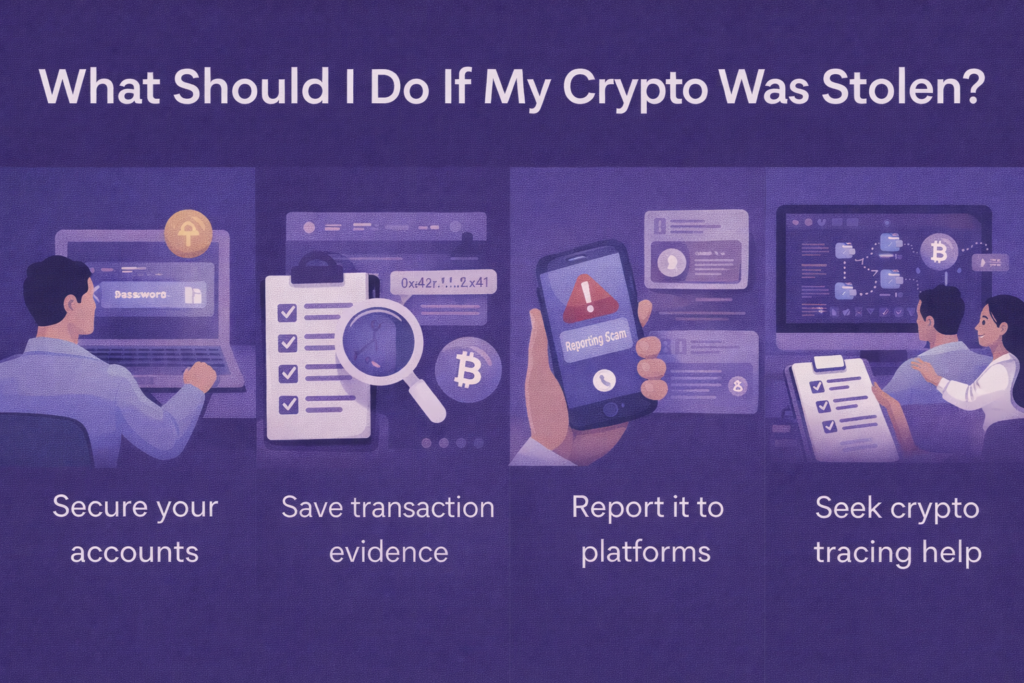
Many individuals mistakenly think that when money is taken (lost) in a crypto theft situation, it is lost forever and will never be able to be located. This could not be any more incorrect than if it were to say it has literally gone up in smoke (disappeared in a puff of “magic”). The truth is that every transaction that occurs with a cryptocurrency leaves behind a record (a digital footprint) that remains saved forever within the bounds of the Blockchain network, and it is only through what is called crypto tracing that Law Enforcement Agencies and Recovery/Forensic Teams can follow the route each stolen crypto asset takes through the Crypto Community until it is either recovered or “frozen” in an account for database purposes.
Throughout the upcoming sections of this paper, we will discuss how a Law Enforcement Agency utilizes this technique to recover stolen crypto funds for victims of scams and other types of Financial Crimes. We will also go into more detail about the importance of crypto tracing to victims of scams and other financial offenses in their quest to recover their funds.
Why Crypto Is Traceable
It is important to note that while cryptocurrency wallets do not show names, they are not kept hidden from view. When you make a transaction with the cryptocurrency wallet, the transaction information including the wallets sending and receiving the funds, the time stamp, the amount sent/received, and the transaction ID will all be available to the public on the blockchain. After they are written to the blockchain, this information can never be changed or deleted.
Investigators can take advantage of this information to trace where your funds went after being scammed, rather than relying on conjecture. The investigators have access to reliable records that anyone could verify themselves.
The First Step: Identifying the Starting Point
In order to track cryptocurrency transactions, it is necessary to start with something you already know. In the majority of cases, this consists of the wallet address to which you sent your funds, as well as the transaction identification number provided by the blockchain.
Using this information as a starting point, analysts are able to track where the funds have gone by examining whether or not the funds were sent to a different wallet, if they were split into multiple transactions, or if they were routed through smart contracts, mixers, and decentralised.
No matter how complex a scam is, there will be patterns that emerge over time. It is essential that we follow these patterns accurately and do not attempt to guess their nature.
Following the Transaction Trail
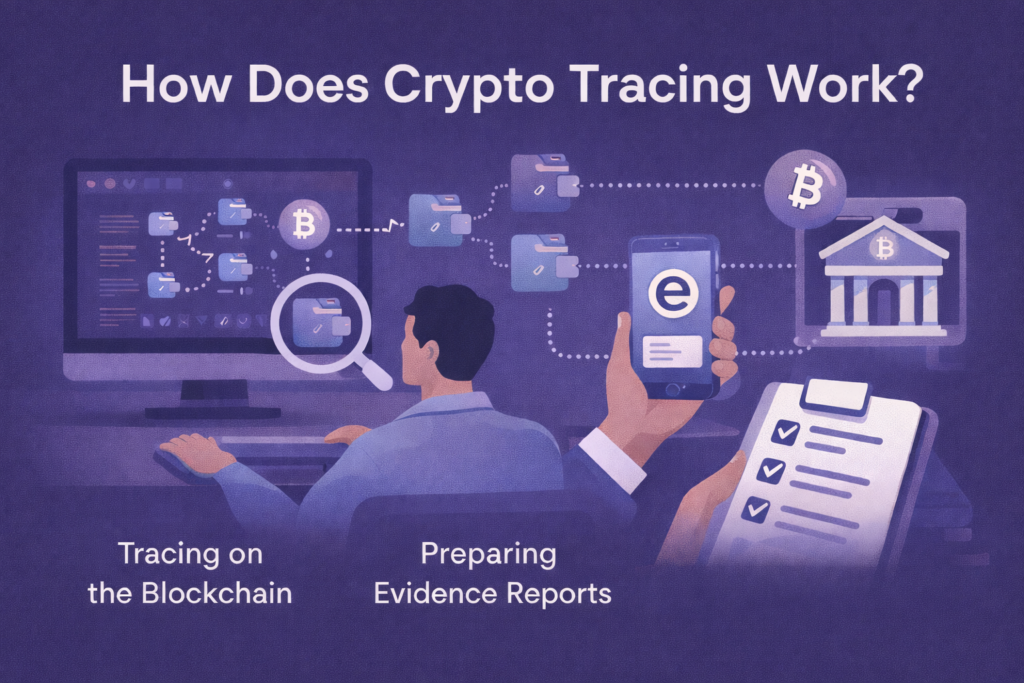
Once the initial transaction is identified, tracing continues step by step.
Investigators monitor how the funds move across wallets and whether they interact with known services such as crypto exchanges, payment gateways, or DeFi platforms.
This stage helps answer important questions:
- Did the funds reach a regulated exchange
- Were they converted into another cryptocurrency
- Were they split across multiple wallets
- Are they still moving or have they stopped
These details matter because recovery options depend heavily on where the funds ended up.
Why Exchanges Are Important
Crypto tracing becomes especially valuable when stolen funds reach a centralized exchange.
Most reputable exchanges operate under compliance rules and require identity verification for withdrawals. If traced funds enter one of these platforms, there may be an opportunity to request account reviews, freezes, or further investigation.
This is why timing matters. The sooner tracing begins, the greater the chance that funds are still within a system that can respond to formal requests.
Turning Data Into Evidence
Raw blockchain data is not enough on its own. Financial institutions and compliance teams need clear explanations, timelines, and supporting documentation.
Professional tracing converts transaction data into structured reports that show exactly how funds moved and why the activity is suspicious. These reports often include transaction paths, timestamps, wallet relationships, and platform involvement.
This step bridges the gap between technical blockchain data and real-world recovery action.
What Crypto Tracing Cannot Do
Crypto tracing does not reverse transactions or magically pull funds back.
It does not break encryption or access private wallets. It also does not guarantee recovery.
What it does provide is clarity. It shows what happened, where funds went, and whether legitimate recovery pathways exist. That information is essential for dispute resolution, regulatory reporting, or escalation to exchanges.
Why Professional Tracing Matters
While blockchain explorers are public, interpreting transaction flows correctly requires experience. Many scams involve multiple wallets, automated transfers, and deceptive techniques designed to confuse victims.
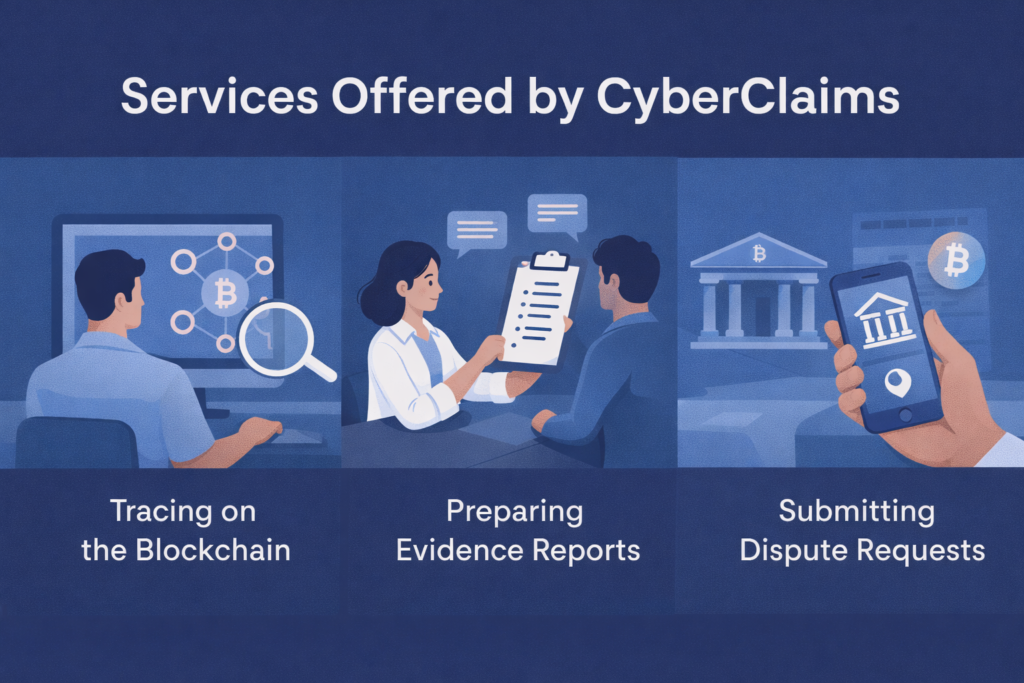
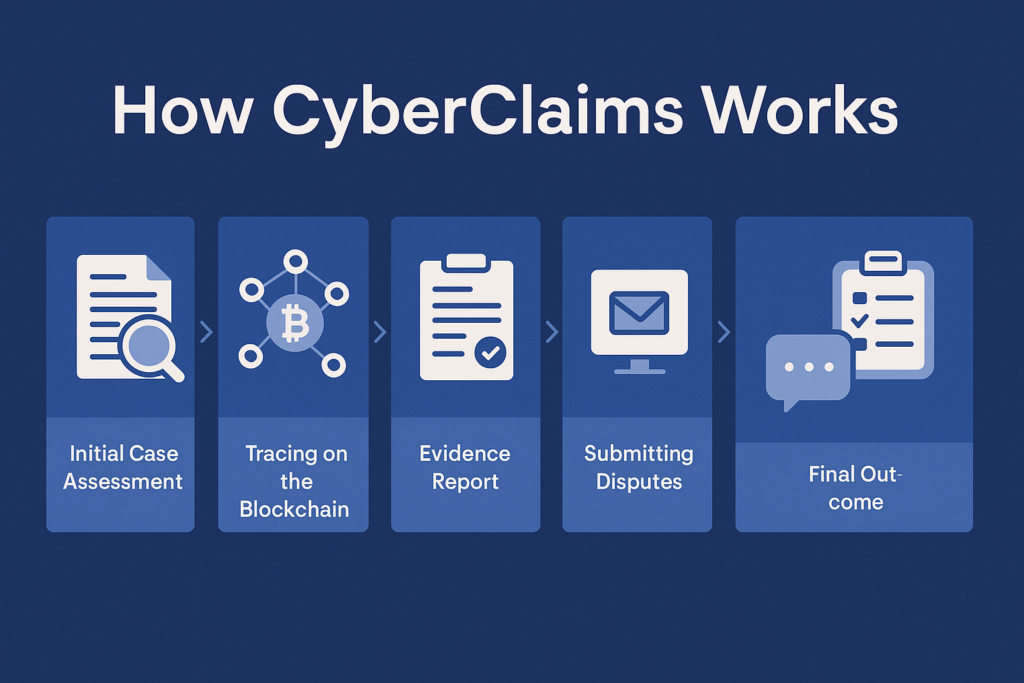
Professional tracing reduces errors, avoids false assumptions, and ensures that any recovery request is supported by accurate data. This is why victims often work with specialist services such as CyberClaims, which combine tracing with formal dispute processes.
Summary
Crypto tracing works by following permanent blockchain records to track stolen funds across wallets and platforms.
It identifies where assets moved, whether they reached regulated services, and what recovery options may still exist.
While tracing alone does not guarantee recovery, it is the foundation for any serious attempt to recover stolen crypto. Without it, victims are left guessing. With it, they gain clarity, evidence, and a structured path forward.